



Last verified: June 2026
Quick Answer
🏨 What are the Pyramids of Giza and who built them?
The Pyramids of Giza are three royal tombs built around 2560–2510 BC near Cairo. Khufu built the Great Pyramid, followed by his son Khafre and grandson Menkaure — the only surviving Wonder of the Ancient World.
🏅 ~2.3 million blocks
built by 20,000 skilled workers, not slaves, over ~20 years.
🏨 Three chambers inside the Great Pyramid
Underground, Queen’s Chamber, and the granite King’s Chamber.
🌍 Original white casing is mostly gone
stripped in medieval times. Only Khafre’s apex still shows it.
💡 More than pyramids
each complex includes a causeway, valley temple, mortuary temple, and mastabas.
Have you ever wondered what makes those stone giants still speak to us after four millennia? In this guide to the History of the Pyramids of Giza, you’re about to explore a clear, friendly account that traces how three 4th-dynasty monuments on the west bank of the Nile became world icons. Whether you’re researching ancient Egypt or planning Cairo tours, you’ll discover why the Great Pyramid and its neighbors shaped ideas about power, ritual, and skill in ancient Egypt and beyond.
This short introduction gives you a quick map: which ruler built each tomb, why the plateau mattered, and how the ensemble earned status as one of the Seven Wonders of the Ancient World and a UNESCO World Heritage Site. Expect plain explanations of construction, design, and ritual use that make complex research easy to follow.
By the end, you’ll see how a single pyramid and a group of pyramids form a coherent royal landscape that still shapes how we study the past and remains one of the highlights of unforgettable Cairo tours.
Key Takeaways
- You will get an overview of the builders and their monuments.
- The Giza plateau links royal tombs to sunset beliefs.
- The Great Pyramid stands as a technical and cultural landmark.
- The site earned global fame as one of the seven wonders and as part of the UNESCO listing.
- The article will unpack the setting, methods, interiors, and later research.
Who Built the Pyramids of Giza?
The Pyramids of Giza were built by ancient Egyptian workers — not slaves. Archaeological evidence from excavations in the 1990s by Zahi Hawass and Mark Lehner revealed a purpose-built workers’ village at the foot of the plateau, complete with bakeries, breweries, and a medical facility. Workers were paid in bread, beer, and clothing, and some were buried with honor near the pyramids they helped build.
The three main pyramids were commissioned by three consecutive 4th Dynasty pharaohs: Khufu (c.2560 BC), his son Khafre (c.2530 BC), and his grandson Menkaure (c.2510 BC). Each pharaoh assembled a rotating workforce estimated at around 20,000 skilled laborers and craftsmen, organized into named teams who competed in productivity. Far from anonymous labor, the builders left graffiti on hidden stones — one group called themselves “Friends of Khufu,” a small but telling sign of worker identity and pride.
Setting the Scene: Giza Plateau, the Nile, and a Wonder of the Ancient World
Stand on the rocky edge west of the Nile, and you’ll see why this plateau drew royal builders. The hard bedrock provided a stable foundation and kept rising groundwater at bay, a key advantage when huge tombs rose skyward.
From Memphis to the Giza Plateau: Why the West Bank mattered in ancient Egypt
The pyramids of Giza sit just across from Memphis, linking royal power to the fertile floodplain. Kings chose this site for its proximity to the capital and for clear ritual lines toward sunset that symbolized rebirth in ancient Egypt.
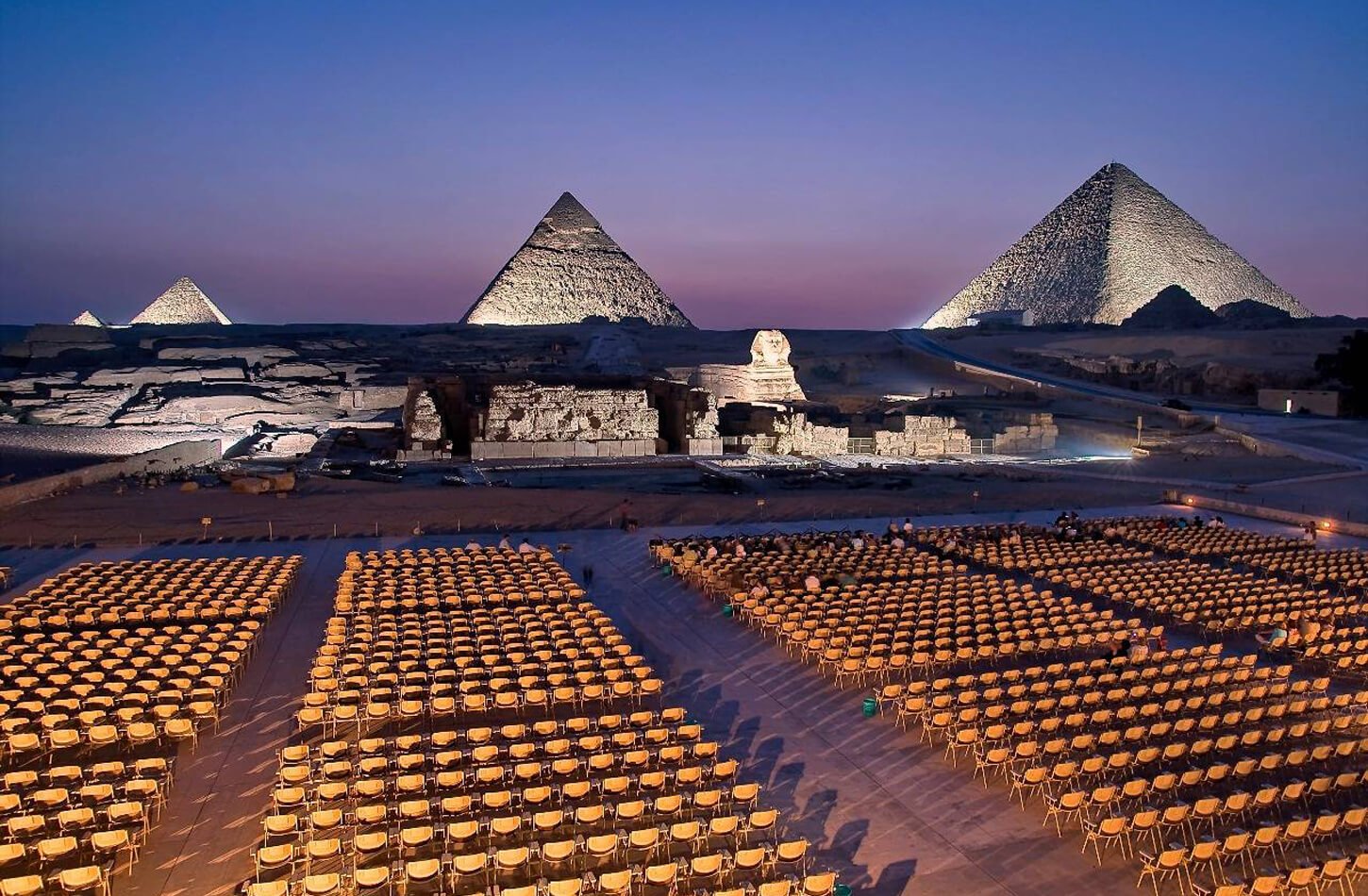
Each pyramid formed part of a larger funerary structure: a valley temple, causeway, and mortuary complex. Those causeways ran from valley temples near the Nile up to temples on the escarpment, creating a ceremonial route visible for many meters.

UNESCO World Heritage status and the Seven Wonders connection
In antiquity, these monuments earned a place among the Seven Wonders of the world. Today, the group is protected within the Memphis-area UNESCO listing (since 1979), which helps conserve the broader cultural landscape.
Nearby mastabas lay out in grids for relatives and officials, extending royal presence across the plateau and shaping how Giza built its funerary neighborhood under the 4th dynasty.
Old Kingdom Origins: Khufu, Khafre, and Menkaure
On this plateau, you will meet three rulers whose tombs redefined royal ambition. Each king set a different scale and voice for later builders in the Old Kingdom.
The Great Pyramid of Khufu: scale, alignment, and original height
The Great Pyramid still defines technical skill. Its base averages 230 meters per side and an original height of 147 meters. Builders set faces at an angle of 51°52′ and aligned the structure to the cardinal points.
About 2.3 million blocks—roughly 5.75 million tons—made up its mass. Nearby finds, such as Queen Hetepheres’ empty sarcophagus, add years of royal context.
Khafre’s pyramid and the Great Sphinx as a guardian monument
Khafre, the son who built Khafre, raised a slightly smaller pyramid on higher bedrock. Its base and height remain visually imposing. The Great Sphinx, carved in limestone near his valley temple, reads as a guardian for that complex.
Menkaure’s pyramid and the shift toward smaller structures
Menkaure’s pyramid drops in scale, at about 66 meters high. That change hints at shifting resources, politics, or priorities within the dynasty.
Together, these pyramids form a planned site: mortuary temples, causeways, queens’ pyramids, and mastabas knit royal memory across generations.
How the Pyramids Were Built: Materials, Methods, and Engineering
You can break down pyramid construction into materials, manpower, and methods that together solved huge engineering puzzles.
Limestone, granite, and tight casing joints
The core used yellowish limestone quarried nearby, while a finer, light-colored limestone formed the outer casing that once made these monuments shine. Granite supplied the King’s Chamber and relieving chambers, giving strength where loads concentrated.
Fine joints and smooth casing set these works apart; casing stones fit with a precision rarer in other Egyptian masonry, which helped achieve sharp angles and smooth faces.
Ramps, sleds, and simple machines
Most scholars favor sloping or encircling earthen ramps as the main lifting method. Workers hauled blocks on sledges, used rollers or wooden levers, and staged moves in short, planned sequences.
Numbers and workforce
The Great Pyramid contains about 2.3 million blocks totaling roughly 5.75 million tons. Those headline figures show the scale of logistics—quarries, roads, and daily delivery systems.
Herodotus wrote that 100,000 laborers over 20 years, but archaeological evidence supports a skilled workforce of nearer 20,000, backed by bakers, physicians, and support crews who kept construction steady over time.
Process, planning, and accuracy
Builders used a modular, course-by-course approach. Orientation to cardinal points and consistent slope angles show careful surveying. Water, sled lubrication, and prepared roads likely reduced friction during hauling.
In short, smart material choices, disciplined planning, and simple machines let ancient teams build the pyramids at Giza with an accuracy that still impresses today.
Inside the Monuments: Chambers, Passages, and Purpose
Step inside these monumental works and you’ll find a clear plan where ritual and engineering meet. Interiors combine narrow routes and grand spaces that guided a royal journey from earth to sky.
Descending corridors, the Queen’s Chamber, and the Grand Gallery
The main north entrance sits about 18 meters above ground and leads down a descending corridor to a rough, unfinished underground chamber. From there, an ascending passage climbs toward the Queen’s Chamber and the soaring Grand Gallery, a 46 m long hall that frames movement and sight.
The King’s Chamber, relieving chambers, and oblique shafts
You enter the King’s Chamber through a narrow passage. It is entirely lined and roofed with granite. Above it sit five relieving chambers that take pressure off the roof.
Two narrow oblique shafts run from the chamber to the exterior. Scholars debate their purpose—whether spiritual pathways, star alignments, or simple ventilation—yet they show how ritual goals and structural needs are combined.
Mortuary and valley temples, causeways, and the afterlife journey
Each pyramid linked a mortuary temple on the plateau to a valley temple near the Nile by a long causeway. These temples anchored ritual activity and directed offerings that sustained the king in the afterlife.
Mastabas and subsidiary pyramids for queens, officials, and kin
Nearby mastabas and smaller pyramids formed a supporting neighborhood. Queens, officials, and kin were interred in nearby tombs that extended the royal presence across a coordinated funerary complex.
In short, the interiors pair precise stonework and planned routes with ritual meaning, while the external casing, once sealed and smoothed, each pyramid to control access and project perfection.
The history of the pyramids of Giza: A concise timeline
A quick timeline will help you pinpoint key moments that shaped construction, study, and legend.
Early steps and breakthrough forms
Around c. 2670 BC, Djoser’s step project at Saqqara began a new funerary path. By c. 2630 BC, Snefru’s Red Pyramid at Dahshur proved smooth-sided design worked, so later Giza was built on a full scale.
Khufu to Menkaure: a tight cluster
Between c. 2560 and 2510 BC, Khufu, Khafre, and Menkaure raised their complexes within a few years. The Great Pyramid and its neighbors set standards in size, mastabas, and ritual chambers tied to afterlife beliefs.
Visitors, tunnels, and early exploration
Herodotus visited c. 480 BC; Roman travelers came from c. 100 BC to AD 400. In 820 AD, al-Ma’mun forced a tunnel into the Great Pyramid, changing access forever.
Modern milestones to today
Davison found a chamber above the King’s Chamber in 1765. Napoleon’s 1798 Battle of the Pyramids and Belzoni’s 1817–18 digs spurred more work. Vyse’s 1837 find and subsequent losses mark the early history of archaeology. Twentieth-century finds include Queen Hetepheres’ equipment (1925) and two boat pits found in 1954. Excavations in the 1980s–90s revealed workers’ districts, and the 1985 Solar Boat Museum and 2021 site revamp improved display and access.
In short, years of study have moved questions from myth to evidence about how pharaohs, workers, and techniques made these world icons.
The End of an Era: Fifth and Sixth Dynasties and Beyond
Late in the Old Kingdom, builders changed what they carved inside burial chambers and how large their monuments rose. New written spells began to shape royal afterlife accounts just as major projects grew simpler.
Pyramid texts and changing royal power
Starting with Unas in the fifth dynasty, priests and artisans inscribed spells and hymns on interior walls. These pyramid texts reframe how you read a dead pharaoh’s journey and show a shift from purely architectural display to scripted ritual.
Pepy II, Saqqara, and the First Intermediate Period
Pepy II ruled for an extraordinary 94 years. His Saqqara tomb rises only about 172 feet, far smaller than the great Old Kingdom giants. That reduced scale signals shrinking resources and a change in how kings projected power.
After his death, the central authority fragmented, and large royal projects largely stopped during the First Intermediate Period. Later revivals in the Middle Kingdom rebuilt pyramid forms, but new structures never matched the earlier scale. Together, texts and tomb size tell a clear story: political shifts reshaped monumental programs and beliefs about rulership.
Archaeology and Rediscovery: What You Learn from the Ground
Digging into the ground near each tomb uncovers tools, food, and homes that tell a human story behind monumental stone.
Queen Hetepheres’ burial equipment and elite life
In 1925, archaeologists found furniture, jewelry, and an empty sarcophagus near Khufu’s causeway. That cache shows court craftsmanship and a practiced ritual transfer linked to royal burial.
Worker villages, bakeries, and workshops
Excavations in the 1980s–90s revealed bakeries, storage rooms, and workshops. They prove that organized teams of skilled workers and laborers lived on‑site for long periods.
Mud sealings, statuettes, and inscriptions on pottery and bone show pride and identity, not anonymous slavery. Worker tombs and nearby mastabas map social layers around the labor zones.
Khufu’s solar boats and ritual practice
Two boat pits found in 1954 and the Solar Boat Museum (1985) preserve full ships. These vessels link temples, the pyramid complex, and sun cult rites across time.
In short, stone toolkits, food remains, and sealings knit a supply chain picture. Ongoing fieldwork keeps reshaping what you know about the pyramids of Giza, from logistics to belief.
The Pyramids Today: Erosion, Preservation, and Enduring Influence
When you compare original profiles with what stands today, the change is striking and instructive.
Loss, measures, and visible crowns
The outer white limestone casing was largely removed in antiquity and during the medieval period. That stripping changed each silhouette and lowered the Great Pyramid from about 147 meters to roughly 138 meters in height today.
Khafre’s pyramid still shows a small crown of casing near its apex, giving you a rare sense of what the original finishes would have looked like. Quarrying and tomb robbing removed many fine stones for other projects.
Sphinx scale and ongoing threats
The Great Sphinx measures about 73 meters long and 20 meters high. It’s a human head and lion body face salt crystallization, groundwater shifts, wind erosion, and pollution—issues that mirror wider conservation needs across the site. Many visitors combine a visit to the Sphinx with a day tour to the Pyramids, Memphis, and Saqqara, gaining a deeper understanding of the royal monuments and the evolution of ancient Egyptian civilization.
Millions still come to see these pyramids and related monuments. Conservation teams balance visitor access with protection, using careful measurement, stabilization, and controlled restoration so that these world icons continue to inspire art, science, and heritage work while remaining a highlight of a day tour to the Pyramids, Memphis, and Saqqara.
Visiting the Pyramids of Giza: What You Need to Know
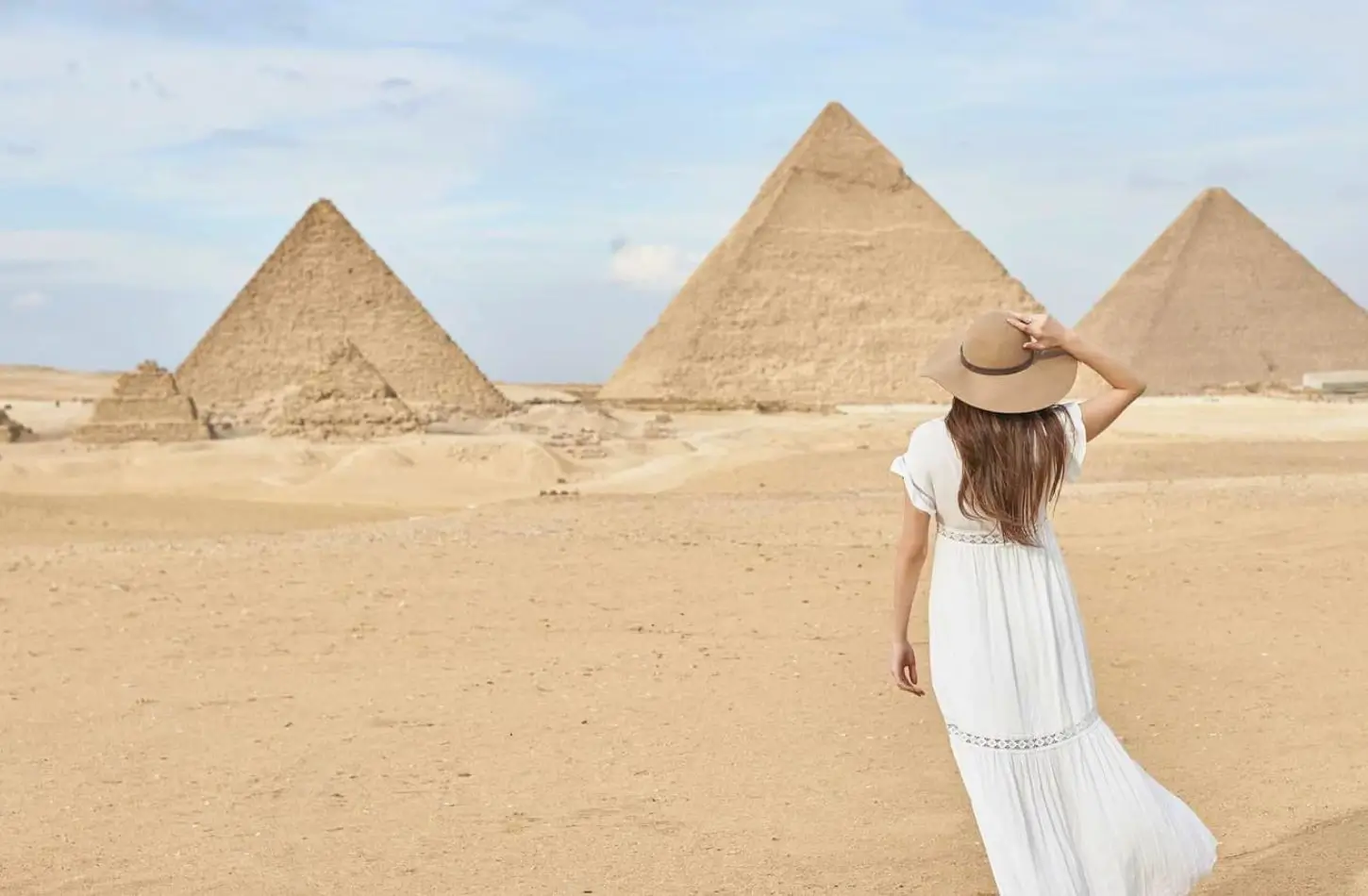
The Giza plateau sits just 15 km southwest of central Cairo, making it an easy half-day tour or full-day trip from the city. The site opens daily from 8:00 AM to 5:00 PM (until 4:00 PM in winter), and tickets are sold on-site or in advance through official channels. Entry to the plateau itself is separate from entry to the interior of the Great Pyramid — an additional ticket is required if you want to climb inside.
The best time to visit is early morning to avoid crowds and the midday heat. The best time to visit Egypt is between October and April when temperatures are comfortable. A private Egyptologist guide makes a genuine difference at a site this complex — the plateau spans over 16 km² and includes not just the three main pyramids but the Great Sphinx, valley temples, solar boat museum, and dozens of mastaba tombs.
For travelers planning a longer Egypt itinerary, the pyramids pair naturally with a visit to the Grand Egyptian Museum (GEM), which opened in 2023 and now houses the world’s largest collection of Pharaonic artifacts — including the complete treasures of Tutankhamun.
FAQS
When was the Great Pyramid of Giza built?
The Great Pyramid of Giza was built around 2560 BC during the reign of Pharaoh Khufu, the second king of the 4th Dynasty. Construction is estimated to have taken approximately 20 years, placing its completion in roughly 2540 BC. It remains the oldest of the Seven Wonders of the Ancient World and the only one still standing.
Who built the Pyramids of Giza?
The Pyramids of Giza were built by three 4th Dynasty pharaohs: Khufu built the Great Pyramid, his son Khafre built the second pyramid and the Great Sphinx complex, and Khafre’s son Menkaure built the smallest of the three. The workforce was made up of skilled Egyptian laborers — not slaves — organized into rotating teams of around 20,000 workers.
Why were the Pyramids of Giza built?
The Pyramids of Giza were built as royal tombs and monuments to ensure the pharaohs’ safe passage into the afterlife. Ancient Egyptians believed the pharaoh became a god after death, and the pyramid — along with its mortuary temple, causeway, and valley temple — formed a complete ritual complex to sustain the king’s spirit for eternity.
How long ago were the Pyramids of Giza built?
The Pyramids of Giza were built approximately 4,500 years ago, during Egypt’s Old Kingdom period (c. 2686–2181 BC). The oldest, the Great Pyramid of Khufu, dates to around 2560 BC — meaning these monuments have stood for roughly 4,580 years as of today.
What is the purpose of the Great Sphinx at Giza?
The Great Sphinx at Giza served as a guardian for Pharaoh Khafre’s pyramid complex. Carved directly from the limestone bedrock, it depicts a lion’s body with a human head, most likely representing Khafre himself. It stood watch over the valley temple and causeway, protecting the sacred royal landscape of the plateau.
Conclusion
Look back now, and you’ll see how engineering, belief, and human work joined to make a lasting royal landscape. The Great Pyramid still shows unmatched scale and precision, while Khafre (the son) and Menkaure (his son) set a family line in stone.
You traced corridors to the King’s Chamber and saw how relieving chambers protect burial rooms for years. Evidence for about 20,000 laborers, quarrying blocks, and careful stone setting helps explain construction speed and skill.
The plateau’s temples, causeways, mastabas, Solar Boat finds, and Hetepheres’ equipment tie ritual practice to everyday life. Even with lost casing and reused stones, the pyramids of Giza remain a clear lesson in how a complex can hold memory across time.
